

Disclosure: We've partnered with CHROMA to bring you this review. Rest assured, we only collaborate with brands that pass our strict testing standards, and we'd never recommend something we wouldn't buy ourselves.
There's only one thing I love more than discovering a new brand that checks all the right boxes, and that's discovering it first. Before the TikToks. Before the restock emails. Before your group chat sends it to you and you have to pretend you didn't already know.
So, for the record: CHROMA by CORPUS launched on September 10. It's been a month. There are about seven reviews on the product page as I write this, and I'm calling it now, these deodorants are going to go viral.
Quick version of what it is. A new line from the team behind CORPUS (the $26 natural deodorant fragrance people have quietly obsessed over for years), launched straight into Target's new Beauty Studio. Two products, three scents, done. Clear gel, no aluminum, no baking soda, and three fragrances that were built like actual perfume.
Which is the part I can't get over. Deodorant that smells this luxe has no business sitting on a Target shelf. And it's clean. And it's $16. I spent the month trying to find the catch (my skin is the reactive kind, and enough "natural" sticks have burned me that I assume there is one). Everything I found is below, including the two things it doesn't do.
The quick details
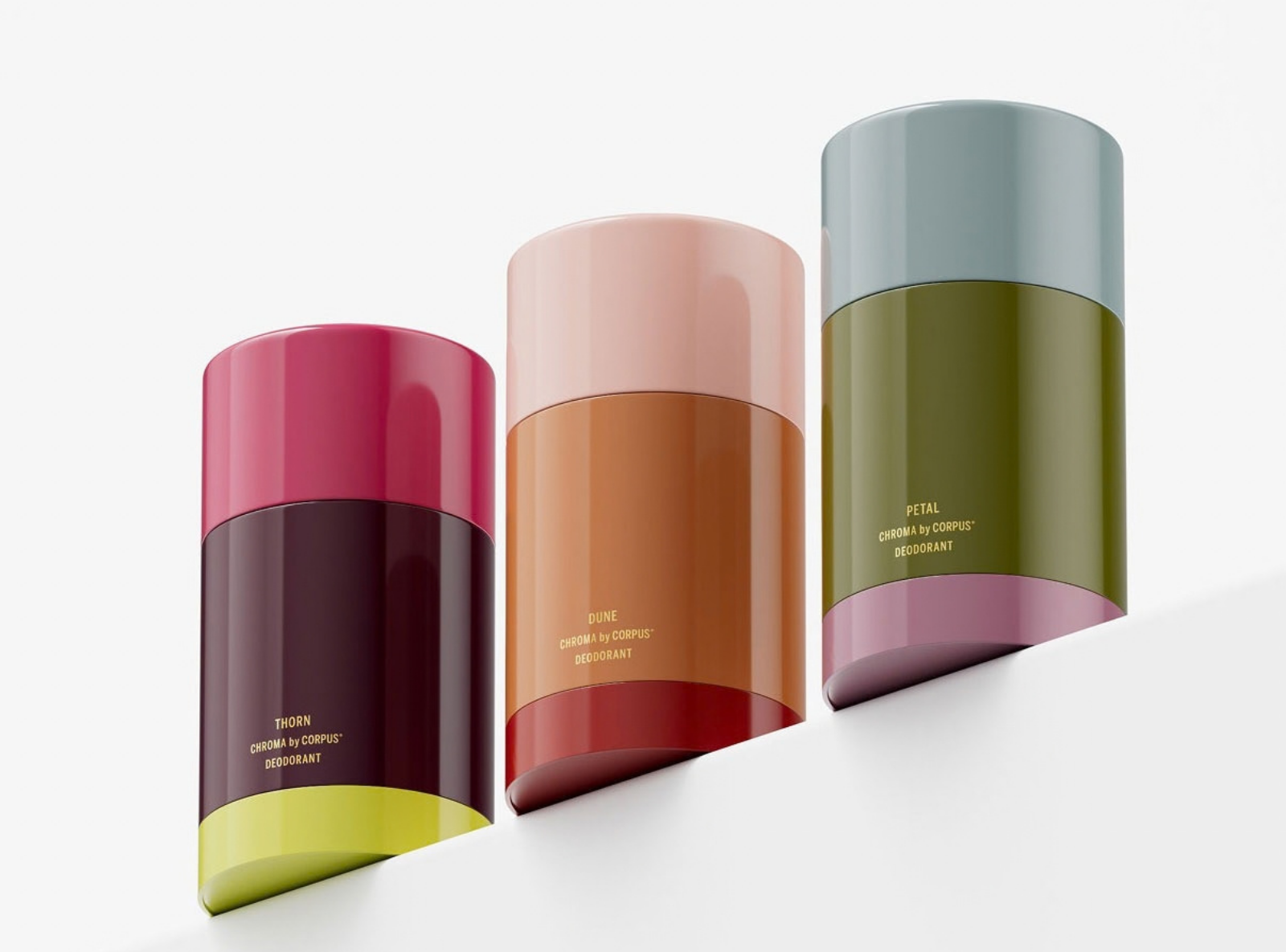
CHROMA by CORPUS deodorant is $16 for 1.6 oz. A clear, water-based gel with no aluminum, no baking soda and no parabens. Three fragrances, all gender-inclusive: DUNE, THORN, and PETAL.
The matching body wash is $32 for 16 fl oz, in the same three scents, with niacinamide, panthenol and a long list of botanical extracts.
Both are vegan, certified cruelty-free through PETA and Leaping Bunny, and made at a solar-powered facility in Southern California. The line launched on September 10 in Target Beauty Studio, and the full lineup lives on the brand's site.
Nothing to decode
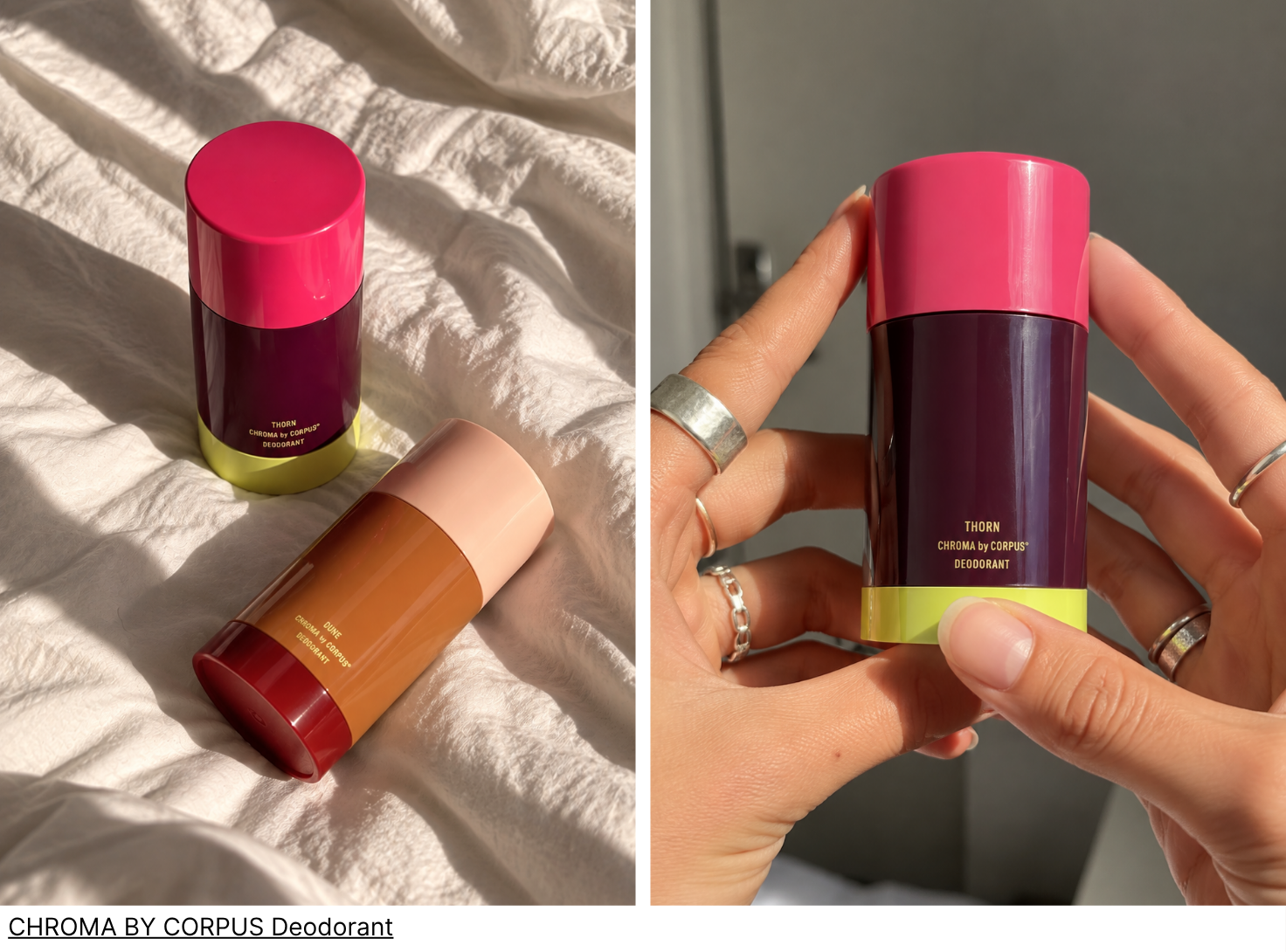
The brand pitches CHROMA as a more vibrant, expressive and accessible take on what CORPUS does, and part of that is restraint. No twelve-step system, no quiz, no "starter kit" you'll regret. Each scent gets a color, you pick the one you want to smell like, and you're done.
The packaging is the first thing people notice
This is the most considered deodorant packaging I've seen, and there's a reason for that.
CHROMA's visual system was designed by Marc Atlan, the art director behind the Comme des Garçons Parfums packaging in the nineties and the Helmut Lang Parfums campaigns. The idea he built it on is in the name: chroma means color, and each scent gets its own color identity, so the bottles read as a set and each one still has a personality. The connection to CORPUS shows up in the details if you know to look, in the silhouette and the gold typography. The Dieline, which covers packaging design, wrote about it in September. That is not a thing that usually happens to a deodorant.
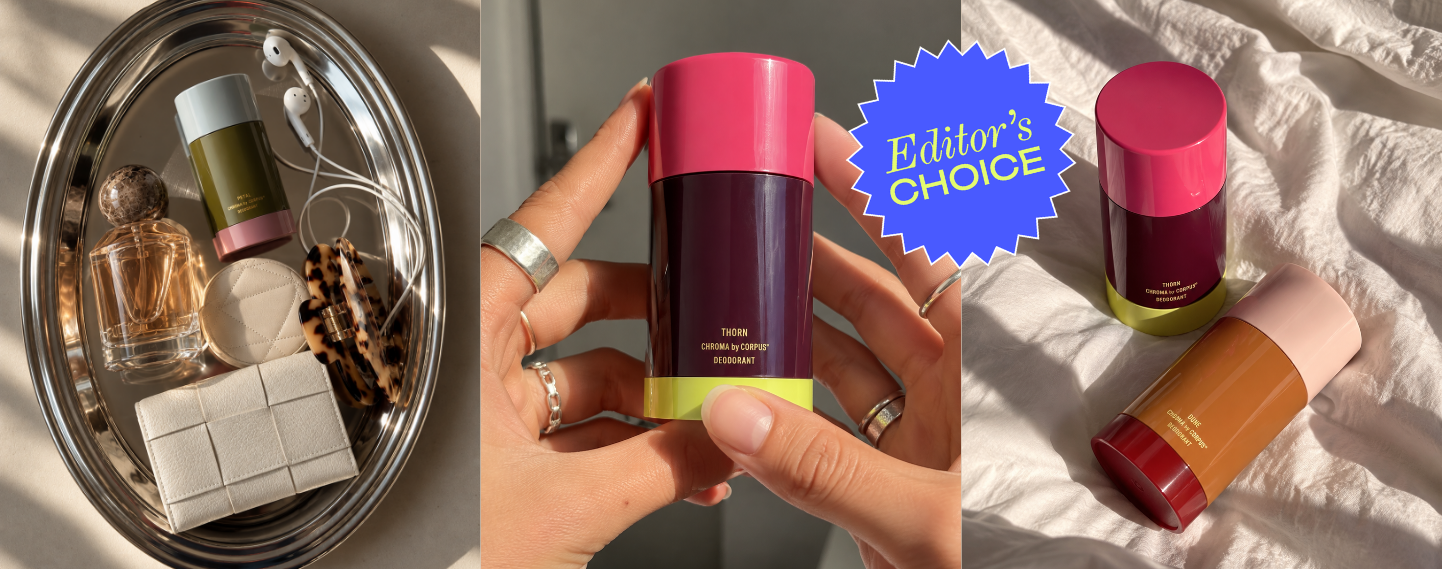
In practice, these live on my bathroom shelf instead of in a drawer, and they get handled. A friend staying over picked up DUNE, turned it around twice, and said "okay, this is gorgeous, what is it?" She'd assumed perfume. She left with the name saved in her notes app.

Then you smell it
These are composed the way fragrances are composed, with a top, a middle and a drydown. Not a "fresh scent" notion. Not a vague clean.
DUNE is amber, musk and sandalwood, the warmest of the three. Creamy rather than smoky, low and close to the skin. The one I reach for at night.
THORN is black currant, rose and white musk. The black currant gives the rose a tartness that keeps it out of powdery territory, which is the trap most rose scents fall into at this price. The most distinctive of the three, and the one that's caused the most confusion at work.
PETAL is jasmine, rose stem and bergamot. Bright and green rather than floral-floral, with the bergamot lifting everything. The one I'd hand someone who says they don't like florals.
The brand won't name a favorite, and having lived with all three, I understand why. They aren't better and worse versions of each other. They're three moods, and the right one depends entirely on what you want to smell like at 8am.

On strength: CHROMA says these are designed to stay close to the skin, subtle rather than overpowering, and that's exactly how they wear. Nobody across a table is getting a faceful. The person sitting next to you, on the other hand, will notice.
A month of actually wearing it
Every morning. It goes on wet, which is the format, with a brief cool moment when the gel meets skin. Then it's gone, in under a minute on me. The brand says it glides on with little to no residue, a claim I expected to be generous. It wasn't. No white marks on a black t-shirt, no chalky cast, no waxy stripe on the inside of a sweater, which is the failure that made me give up on two natural deodorants before this one. One instruction actually matters: apply to clean, dry skin after you shower. Wet skin dilutes a water-based formula, and you'll get less out of it.
The office. About ten days in, a coworker came by my desk mid-afternoon and asked if I'd changed my perfume. I hadn't changed my perfume. I wasn't wearing any. I'd changed my deodorant, to THORN, and the black currant was apparently doing a lot more than I'd given it credit for. I told her, and she said "no, seriously." I said seriously. I've had a version of that conversation twice more since.
The gym. This was the test I was most skeptical about, and I want to be precise about it, because a deodorant can't do everything. I wore PETAL to a 6pm class, the kind you leave genuinely wrung out. I sweated. Obviously I sweated, there's no aluminum in this and nothing was going to prevent that.
What didn't happen was the turn. No sour note at minute forty, nothing when I pulled my top off in the locker room, nothing in the car on the way home. The gel didn't ball up or go tacky once I was damp, which is what cream deodorants do to me. The bergamot was still faintly there underneath the whole time. I got home and didn't walk straight into the shower, which is not how my gym nights normally end.
The birthday dinner. I wore DUNE to a friend's birthday, applied around six. Somewhere between the bread and the mains, the friend next to me said I smelled amazing and asked who made it. I told her. She looked it up under the table and found the product page and not much else, because the brand had been out for three weeks. It's an oddly satisfying position, being the person at the table with the answer nobody has yet.
Dinner turned into a bar that was louder and warmer than anyone planned. I didn't touch it up, mostly because I forgot I'd need to. Around midnight, hanging my jacket up at home, I caught the amber again. Faint, but still there, and still smelling like the thing I'd put on at six rather than the evening I'd had.

What's in it, and what that means if your skin is reactive
CHROMA publishes full ingredient lists, which is more than a lot of this category does, and the formula explains why it behaves the way it does.
The odor work is done by a fermented active, saccharomyces ferment filtrate, alongside sodium surfactin, with diatomaceous earth and silica handling absorbency. That's an enzyme-and-ferment approach rather than an acid one. The clear deodorants built on mandelic or glycolic acid can sting on freshly shaved underarms. This one didn't, because there's no acid in it to sting with. It's also formulated without baking soda, which some people find irritating.
A month, every day, no reaction. That's my experience and the only one I can give you.
The honest other half: the formula contains alcohol denat and isopropyl alcohol, which is how a water-based gel dries that fast, and it's fragranced, by design. If you react to fragrance or to alcohol in a leave-on product, those are your two things to watch. CHROMA's own answer on sensitive skin is to check the ingredient list rather than to promise it's fine for everyone, which I trust more than a blanket reassurance. If your skin has opinions, patch test a small section first.
The body wash is the part I didn't expect to care about
I almost skipped it. Sixteen ounces for $32 felt like the upsell.
I'm glad I didn't. It lathers properly, rinses clean, and doesn't leave my skin feeling stripped, which is a low bar that a surprising number of scented body washes fail. Niacinamide and panthenol are in there with jojoba, argan, chamomile, marshmallow root and green tea. The brand says these support skin balance. I'd describe the effect as not-dry rather than treated. It's a body wash, not a serum.
It's also the same color system as the deodorants, so it looks right in the shower, and it's a big bottle that lasts. Matching your wash to your deodorant is a nice touch, not a requirement. The deodorant stands entirely on its own.

The honest part: this is a deodorant, not an antiperspirant
It will not stop you from sweating. Nothing without aluminum will. The American Academy of Dermatology is clear on this: only aluminum compounds plug sweat ducts, which is what an antiperspirant does. A deodorant works on odor instead.
If you're buying this expecting dry underarms, you'll be disappointed, and that's the most common reason people leave one-star reviews on natural deodorant. My gym test is the honest version of what it can do: I was wet, and I didn't smell.
While we're being honest about aluminum, the reason to go aluminum-free is preference, not fear. The American Cancer Society and the National Cancer Institute have both looked at the antiperspirant-and-breast-cancer question and found no credible evidence of a link. There are plenty of good reasons to skip it, including that aluminum salts are what yellow the armpits of white shirts. A health scare isn't one of them, and I'm not going to pretend otherwise to sell you something.
If you're switching from antiperspirant, give it two weeks
You may smell worse for a stretch. That's real, and the usual explanation for it is wrong.
It isn't a detox. There's nothing accumulated to flush out. What's happening is a microbiome shift: a 2016 study in PeerJ found that when habitual antiperspirant users stopped, the bacteria on their skin rebounded within days toward Corynebacterium, the genus most responsible for underarm odor. Aluminum had been suppressing it. Take the aluminum away and the population rebalances.
It settles. Mine took about ten days. If you switch on a Monday and judge it on Wednesday, you'll judge it wrong.
Who's behind it
CORPUS launched in 2018, and its $26 deodorant has spent the years since as the one fragrance people recommend to each other when someone says natural deodorant can't smell good. It was founded by J.P. Mastey, who before this ran Baxter of California, the men's grooming brand L'Oréal bought in 2013. So the fragrance competence has a track record behind it.
Their ingredient position is unusually grown-up for clean beauty: "safe is not about whether something is natural or synthetic, it is about how it is used." They call the approach Modern Botanical + Molecular™, meaning botanicals where botanicals perform best and vetted aroma molecules where those are safer or more stable.
The fragrances meet IFRA and EU cosmetic regulations, and the formulas leave out phthalates, nitro and polycyclic musks, and endocrine-disruptive solvents. It's a more defensible place to stand than "all natural," and it's why the scents smell the same in week four as they did in week one.
On the Target Clean badge: it's Target's in-house standard rather than a third-party certification, and it means the formula skips phthalates, propyl- and butyl-parabens, and SLES. The PETA and Leaping Bunny certifications are the third-party ones.
Let's talk about the price
$16 for 1.6 oz works out to $10 an ounce, roughly double a mass-market natural deodorant. That's a real gap and it deserves a real answer.
First, it's exactly the same price per ounce as CORPUS proper, which costs $26 for a bigger stick. CHROMA is a lower entry ticket and a wider distribution, not a cheaper formula. Second, the stick is genuinely small, and the one critical review currently on Target says precisely that. If you measure deodorant by volume, this will annoy you.
What you're paying for is the fragrance and the design, and both are visibly where the money went. If those matter to you, $16 is a fair price for something this considered. If they don't, a $6 stick will do the job you need done.
Who this is for, and who should skip
Get it if you like finding things before everyone else does, you care how the objects in your bathroom look, and you want your deodorant to smell like something rather than like nothing. Also if white marks or waxy transfer have put you off natural deodorant before.
Skip it if you sweat heavily and need dryness rather than odor control. Skip it if you need fragrance-free, because all three are scented and there isn't an unscented option. Skip it if alcohol in a leave-on product is a known problem for your skin. And skip it if you want the most product for the money, because you won't get it here.
One more thing I'd want told to me: this brand is a month old, so the independent evidence is thin. There are a handful of early reviews and no third-party testing yet. What I can give you is what a month of my own wear looked like, which is a strong personal result and not proof.
The bottom line
I'm standing by the prediction.
A month in, CHROMA is the first deodorant I've chosen by smelling it, the first one I've kept on the shelf instead of in a drawer, and the first one I've ever been complimented on. It goes on clear, it's gone in under a minute, it got me through a 6pm class and a midnight jacket test, and my reactive skin hasn't objected once.
Nobody has guessed it's deodorant yet. I've started taking my time correcting them. Bookmark this for when your group chat catches up. 🌿
[box-c: chroma-corpus-deodorant]